
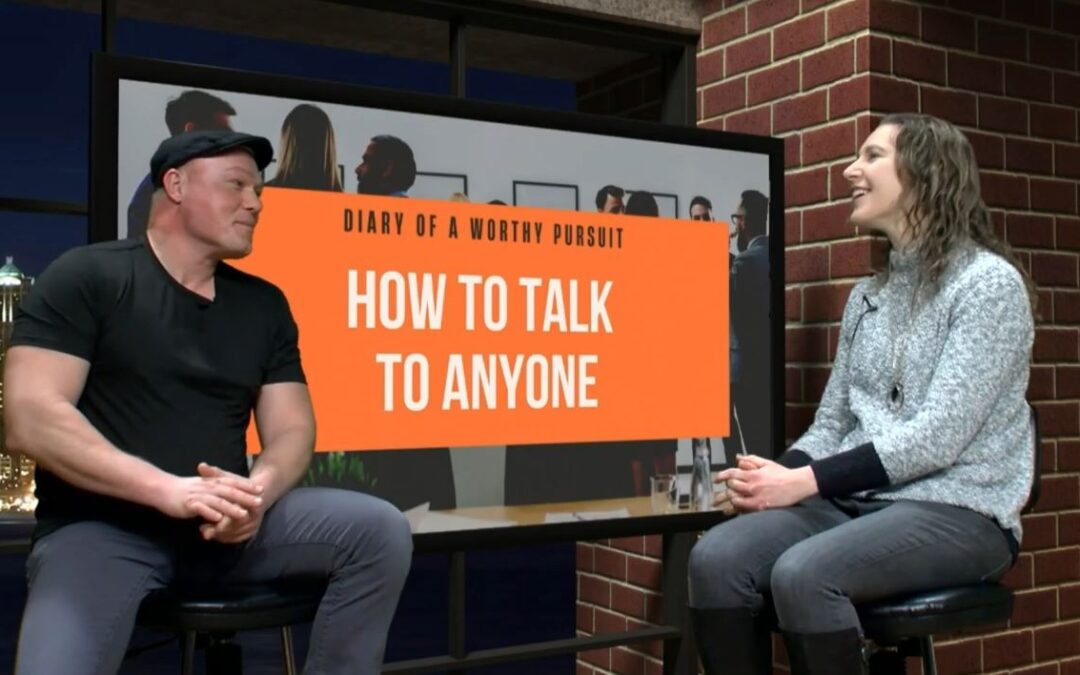


On this episode of Diary of a Worthy Pursuit, Jenna and James discuss how to talk to anyone, offering insights into the art of conversations in various settings. The hosts provide tips on how to ask effective networking questions that encourage people to open up about their passions, and they emphasize the importance of active listening to make conversations more meaningful. The episode also covers the use of scripts in sales and how to negotiate discounts, as well as ways to overcome the generational divide in communication methods. They provide practical tips on how to have fun conversations in social events and how to make a conversation meaningful with active listening. Tune in to this episode to learn how to mindfully converse with others and make meaningful connections.
-
How to Start a Morning Ritual
Apr 13, 2023 •
Jenna [00:00:07]: So I used to wake up in the morning in a crazy start. My kids would run in, they’d be screaming, Owen didn’t do this. Callan woke me up. Where’s my breakfast? And I roll over and it’s 06:00 luck. Awesome. Didn’t wake up before the kids, and…
-
How to Be Confident
Apr 20, 2023 •
James [00:00:06]: I’d like to tell you a story about a guy that wasn’t the most confident in the world at a moment with short cutoff jean shorts. So picture yourself let’s call it a weekend. In September, I’m in Wisconsin Dells at the Wazawa Festival, which is the end…
-
How to Reach Email Inbox Zero
May 18, 2023 •
-
How to Increase Revenue
May 11, 2023 •
-
How to Stop Procrastinating
May 4, 2023 •
Podcast Transcription:
James [00:00:06]:
Have you ever been to a wedding or networking event or hanging out with some people that you don’t know and you just had a hard time? You’re looking around and you can tell that some people are having a good time, they’re having fun, they’re talking to each other, they’re laughing, and you are looking at that room feeling like either no one knows you exists, or worse, no one cares. S let me tell you a really quick story about the first time that I went to a networking event. When I first started my business, we’ll just say a long time ago, I went to a networking event not knowing what a networking event was. But somebody told me, hey, you got to go because you’ll meet a bunch of people, they’re cool, plus they have beer, and why not? So I go to this event, which happens to be at some hotel, and I’m seeing a bunch of people, they’re shaking hands and they’re talking, and I know absolutely no one. And so the first thing that happens is you start to sweat a little. It’s not warm in there. You’re just feeling nervous. And then you think, well, how am I going to meet these people? I’ve never that I remember, anyways, walked up to someone and said, hey, how’s it going? Buy something from me. So I decided the first stop is going to be to get a beer, loosen up. And I figured there’s a line there. And then I learned very quickly that when people are in line for something, it is very easy to make conversation with them because you’re both just waiting there, literally waiting with nowhere else to go, and you might as well talk to the person next to you. So I said, hey, how’s it going? And then I asked them where they’re from, and then I talked to them about their business. And before I know it, without even intentionally meaning to, I started to learn about this person. We swapped some business cards, and I learned the best place to meet people at a networking event is in the beer line. So lo and behold, I’m not a crazy drunk. But I did find it useful to go back into that beer line every half hour. I didn’t really care about the beer. What I cared about was it was very easy to talk to people. And so here we are.
Jenna [00:01:59]:
Welcome to a diary of a worthy.
James [00:02:01]:
Pursuit, how to get what you truly want in life and business.
Jenna [00:02:06]:
So today we’re going to be talking about how to talk to anyone. James, why is this so important in a business?
James [00:02:13]:
Well, I would say in the end, the rule is it’s not who you know, it’s who knows you. And nobody knows you if you don’t talk to them.
Jenna [00:02:22]:
Right? But your story was a great example of walking into a networking event. When I talk to people about how do you grow your business. I hear so much, oh, just go out and meet people. Just go out and do some networking. And it can be extremely scary, especially if you’re a new business owner who’s never had to talk to people you don’t know, worry about growing a business, and then you think, how can going to a networking event actually help me grow my business?
James [00:02:45]:
It’s tough. It’s challenging. I always joke that it’s a group of sharks trying to sell each other. Specifically, the people that are going to networking events are probably trying to sell something or represent or something. They’re not going there necessarily to buy from you.
Jenna [00:02:59]:
Right.
James [00:02:59]:
So it’s interesting because then a joke like how many mortgage brokers are here? How many financial planners are here? How many people are trying to sell me life insurance? And so on top of getting out of your shell and talking to them. Now, once you get that conversation going, you got to be like, oh, I don’t want to talk to you anymore. I have to move on.
Jenna [00:03:19]:
Well, and I think there’s something, too. We start a business not necessarily because we know how to market it or sell things. So I’m a really good bookkeeper or I’m a really good graphic artist, but going out and talking to people isn’t my strength.
James [00:03:36]:
No.
Jenna [00:03:37]:
So that’s why I think this topic today is so important. Because in a new business, you have to learn how to talk to anyone at a networking event or some prospect that might call up or even if you’re interviewing a prospect to see if they’re a good fit for your company. You still have to be able to pull the right information out of that.
James [00:03:54]:
Oh, it’s a must to be able to ask the questions, to be able to get them to give you the answers that you need to figure out whether it’s a good fit or not and to make it all. Comfortable so that people aren’t feeling all tense and like.
Jenna [00:04:06]:
And then to develop that idea of trust so they want to work with you and that you can actually get past that prospect meeting.
James [00:04:12]:
Huge.
Jenna [00:04:13]:
Yeah. So today we have three ways that you can talk to anyone by following these three steps.
James [00:04:20]:
First one we have is to ask questions. I’m going to play a little game with Jenna that I showed her before. We’re going to have a little conversation. You can tell us how it goes. So, Jenna, what’s your favorite color?
Jenna [00:04:30]:
Blue.
James [00:04:31]:
End of conversation. The end of conversation because Jenna didn’t ask me a question to keep the conversation going. So we’re going to try again, but you’re going to ask a question back.
Jenna [00:04:41]:
Okay.
James [00:04:41]:
So I’m going to say, Jenna, what’s your favorite color?
Jenna [00:04:43]:
I really like blue. James, what’s your favorite color?
James [00:04:46]:
My color? Would you be surprised if I told you my favorite color is green?
Jenna [00:04:49]:
I would, because you wear a lot of black.
James [00:04:54]:
You know, the interesting thing here is the rule is that the person that asks the question controls the conversation. So let’s try it again. Jenna, what’s your favorite color?
Jenna [00:05:04]:
I really like blue. James, what’s your favorite color?
James [00:05:07]:
I love that there are cameras all around us. Have you ever been on the camera before?
Jenna [00:05:11]:
I haven’t been on camera. It’s really interesting. I was a little nervous before coming today. No joking, but it’s interesting if you could see how James redirected the conversation from the color that we were talking about to something a little bit more interesting that was diving deeper with me. And he got me to talk and maybe even open up and tell a story. And he had a really good way of transitioning with a question, which I.
James [00:05:36]:
Think you can ask anything. So I could ask you about shoes, lights, building across the street, whatever, and you have to at least think about it. Even if you don’t answer it, you have to think about the answer.
Jenna [00:05:48]:
Right.
James [00:05:49]:
And so the person that asks the question controls the conversation. So the fun game is when you get two salespeople going, they each try to take control of the conversation just like you were doing, right. So you answer and then ask a question again. And it’s fun because then it’s somewhat of a volley.
Jenna [00:06:07]:
And it’s interesting when you can kind of step above a conversation like that and look at the tactics of what people are using. Because I think when you’re in the conversation, sometimes it’s harder to see what the next best step is. But when you have had enough of these conversations, you can kind of see the path of how you can get toward getting to know someone better. Because a networking event isn’t about selling them. It’s just about getting to know someone better.
James [00:06:31]:
Yeah. Because you don’t know who they know. So even if they’re not ones that is going to are going to give you a bag of money, right. They may know someone that wants to.
Jenna [00:06:41]:
Give everyone I met at a networking event gave. Yeah, right.
James [00:06:43]:
That easy. It’s that easy. It’s funny because with the questions that you ask, you turn into a salesperson. But not in I don’t want to use that in Derogatory, which I was teaching a class, business planning class, and I was teaching them this about the questions. And when I brought up the word salesperson, they’re like, whoa, sales feels dirty.
Jenna [00:07:06]:
We feel like used car salesman is going to follow me around. Or sometimes furniture store. I walk in a store and the person follows me around again. If you’re in those businesses, I’m sure you do a lovely job. But that’s the perception, right. And nobody wants to be sold, but we want to buy the things we want, and we want to be served. So that’s, I think, another thing that questions really help with is it doesn’t make me feel like I’m being sold. It makes me feel like you just want to know more about me.
James [00:07:32]:
Right.
Jenna [00:07:32]:
And as the question asker, you can make sure you’re asking questions that then get people talking about themselves. And two things I learned, I believe it was in Dale Carnegie’s, one of Dale Carnegie’s books. One is everyone loves the sound of their own name.
James [00:07:47]:
Yeah.
Jenna [00:07:47]:
And then two is the more you get someone to talk about themselves, the more they think more highly of you as a person. So if you’re asking me questions and I’m talking about myself, I’m probably going to leave that event saying, gosh, that James, he was a really nice guy. I probably want to go make sure I can have coffee or reconnect with him or make sure I see him out at the next event.
James [00:08:08]:
I hope so.
Jenna [00:08:08]:
Right.
James [00:08:10]:
The interesting thing is you ask people questions to try to find commonality. So where do you work, where do you live, what do you drive? Whatever. Trying to find something that we have in common.
Jenna [00:08:20]:
Right.
James [00:08:20]:
Which is a common salesperson tactic.
Jenna [00:08:22]:
Yeah.
James [00:08:22]:
But I suppose it also goes beyond that to a more personal level where you’re just like, I want to know if I should hang out with you or not.
Jenna [00:08:29]:
Right. And I think each of us has this deep desire to connect and belong. I think one of the things that we learned in COVID was that when we were all locked up, we missed this connection that we had with people hugely. And some of us almost forgot how to connect with people. So as these networking events are happening again and we’re all kind of getting out there again, we’re all relearning these things. And so I think this is really good review for anyone, but that idea that now I’m out there again and I want to connect, but I also want to feel like I have some belongings. So finding that common ground is really helpful to building a future connection.
James [00:09:06]:
That’s funny, you mentioned the COVID thing. Somebody asked me a few weeks ago for a business card and I was pulling up my little business card thing and I was like, I don’t think I’ve opened this for two years, maybe three years, whatever. It’s been a long time since anybody has asked for a business card because they just haven’t been in a setting for that to even come up.
Jenna [00:09:25]:
Right.
James [00:09:26]:
So it’s one of those like, do I have a business card? I think I do.
Jenna [00:09:29]:
Maybe it’s time to update them.
James [00:09:30]:
Maybe, yeah. I don’t know. One of those like, here’s the QR code. Right, whatever. Just something different. What else do we have here?
Jenna [00:09:39]:
So step two is go deeper. And James already gave an example of this. But let me role play this a little bit so you can see what this looks like. So James, what do you do when you’re not coming to networking events? And hanging out in the beer line.
James [00:09:57]:
I dream of warmer days when I can ride my motorcycle.
Jenna [00:10:01]:
Oh, interesting. What kind of motorcycle do you drive?
James [00:10:04]:
I have a few fast one, a kind of fast one and one for the dirt.
Jenna [00:10:09]:
So when do you use each one?
James [00:10:11]:
The dirt one in the dirt and the fast one or the between the two fast ones, they both have their pros and cons. So there’s a little road by my house that’s curvy, and you can take 20 minutes and forget the world for a little bit on the curves and stuff like that. Because if you don’t forget the world and you think about the world, you probably go off one of those curves, which is a bad day. So it’s almost forced meditation to a point.
Jenna [00:10:39]:
So see in that conversation how I could have just said, oh, you have three motorcycles, cool. What else do you drive? Or I could have moved on to another topic, but instead I used the information that James gave me and I dove deeper. I asked about where do you drive those? Maybe I should have asked where you drive. I think I asked you when because where you drive on the dirt would be interesting too. But it’s just this idea of taking the information that they give you and dive deeper. And one of the things that I learned about James just now by diving deeper is that motorcycle driving is like meditation to him. And gosh, that’s a really deep conversation that I may not have gotten to if I didn’t ask a more probing question. So how do you use this in your business?
James [00:11:23]:
I suppose just like you said, right? You take their answer and when you ask a question that relates to their answer, that proves that you listened and it shows interest. So it just helps the conversation and the relationship go along because you’re showing interest in what they gave an answer to. And so you’re just proving that I listened.
Jenna [00:11:44]:
Right.
James [00:11:44]:
Instead of asking a question. Completely irrelevant.
Jenna [00:11:47]:
And that’s what we all want to we all want to be listened to and heard. I think there’s nothing more discouraging, especially in a doctor’s office, to me, when you feel like no one’s looking at my eyes, no one’s listening to what I’m saying, and you’re already formulating the next question you’re going to ask me before my answers even come out to.
James [00:12:05]:
The doctor or the nurse.
Jenna [00:12:07]:
Well, yes, because sometimes they’re just stuck in the computer and they don’t even really listen right. Like, do you have any allergies, yes or no? Okay, moving on to the next thing.
James [00:12:17]:
Just filling out the form.
Jenna [00:12:18]:
Just filling out the form.
James [00:12:19]:
That is so checklist. I just had a conversation with one of my agents yesterday about that. So we do these call audits, right? So I have a call answering service. We’re doing call audits. So we listen to a call recording and just audit it, see how good it was, see how bad it was, what mistakes, all that kind of stuff. So we have a flowchart. It’s all if then, right? If somebody calls a plumber and we answer the phone for the plumber and they say, I got 3ft of water in my basement, whatever, we have these questions that we ask client answers. Do you schedule it? Move on with your life? So the call on paper was flawless. The agent followed the flowchart. But our big thing that we do for the call audits is how did the caller feel when they hung up that phone? Did you help them one? But did you also help them feel better? So I’m like, any call answering service can do fill in the blank, fill out a form. But for a person to help an agent, to help that person feel good in a time that may not be the greatest, right? Sometimes they’re calling a scheduled massage, but in this case, the guy was calling with he had water in his basement. So not the greatest call in the world, but it wasn’t yeah, whatever. He wasn’t necessarily happy, but he was like, hey, I got to solve a problem. I call this place to solve a problem. And the agent solved his problem, but she didn’t do him any favors. She didn’t joke with them, have a good time with them, try to put them in a better light. And so I’m like, do I have to tell people on the flowchart? I joked with the agent saying this to try to point out how obvious it should be. I thought it was I’m like, do I have to put on there to have fun or to help to help this person, right? And when you’re at the clinic, I know exactly what you’re talking about.
Jenna [00:14:05]:
So I have another example. I worked at a more rigid call center. We were renewing newspaper subscriptions or upgrading cable service, things like that. And it was the same thing. I had scripts, which can be extremely helpful in a sales situation. It gives you something to talk about, but it shouldn’t be the only thing that you reference because otherwise you’re going through your sales script and being on the I’m sure you all have received calls from Telemarketers, but being on the other end of it is so interesting because it’s like how are you feeling about your newspaper subscription? And then they say, Actually, I hate it. You throw it in the front yard and the neighbor’s dog poops on it each time and you need to put it in a better spot. And the next question on my checklist is something like that’s great. Do you want to upgrade to get it every day of the week? And if I followed that checklist, that person would be like, no, I don’t. I want you to put it in a bag and put it in the box, and then maybe I’ll consider not canceling. So it’s so interesting, I think, where we get so used to these ideas of checklists, and they’re extremely helpful in certain situations, but we can’t forget that people are human.
James [00:15:13]:
Yes, they told us to be human.
Jenna [00:15:15]:
On the other side of that call or whatever it is that email that you’re sending out. So I think it’s extremely important to remind ourselves and we should all have a little fun in what we’re doing anyway, otherwise totally. Why are we doing this? If my day is just full of checklists and things like that, I’m going.
James [00:15:31]:
To hate my job, right?
Jenna [00:15:33]:
So I love that idea of a check mark for have some fun or ask their feeling what a great way to instill some feedback.
James [00:15:42]:
This guy even made a joke because one of the questions was, is this an urgent matter? And it comes down to, like, are you willing to pay for the plumber to come out tonight, tomorrow? And the guy joked, like, what does that even mean? Right? Just kind of like, what does the word urgent mean? Are we talking like urgent? Like, send an ambulance kind of thing? He just kind of had fun with it, and the agent had none of it. She didn’t even respond to his little and it’s his basement that’s got the water in it.
Jenna [00:16:09]:
Right.
James [00:16:10]:
I’m like, he’s trying to have fun. Like, this is a decent guy, just has a little problem, and you’re just like, no, not having it. I need to know if it’s urgent or not.
Jenna [00:16:22]:
So I guess this tip is go deeper, but read the cues of who you’re talking to and have a little bit of fun. Make sure to be human.
James [00:16:30]:
Yeah. There’s a natural flow, right?
Jenna [00:16:32]:
There should be if you’re listening and not following a checklist.
James [00:16:36]:
Because we’re human, right? We’re not robots. You look at chat GPT, right?
Jenna [00:16:40]:
Yeah.
James [00:16:40]:
And I joke with my crew. I’m like, if your call sounds like you could be replaced by a robot, you will.
Jenna [00:16:45]:
Right. Human intelligence.
James [00:16:49]:
Yeah. It’s just one of those things because software can follow the checklist exactly.
Jenna [00:16:53]:
Well, that’s what Chat bots do on websites all the time. I see that there was a keyword about billing. Let me send you to the accounting department. Well, that doesn’t make any sense.
James [00:17:02]:
No. Yeah, fair.
Jenna [00:17:04]:
Yeah.
James [00:17:05]:
What’s our next point here?
Jenna [00:17:06]:
So the next one that we recommend is listening and observing in conversations. Talk to me about a time where you’ve really seen this work for you.
James [00:17:16]:
Well, I volunteered with big brothers. Big sisters?
Jenna [00:17:19]:
Okay.
James [00:17:20]:
So I have little brother Danny, or had little brother Danny. He’s a big kid now. Anyways, we would normally get together on Tuesday, something like that. So Big Brothers Big Sisters people don’t know an adult volunteers to just hang out with a kid. It’s a great organization because typically these kids either are missing a parent for some reason or another, or their life situation is not the greatest in the world.
Jenna [00:17:44]:
Positive influence.
James [00:17:45]:
Yes. They need someone to help them out, someone to show them the world kind of thing. So. Danny’s. His name Danny’s. Great kid. And I would say, hey, Danny, how’s it going? What’d you do this weekend? And he’d be, typical teenage answer, nothing. And so I would joke, right? I’d go deeper, and I’d say, did you lay on living room floor and stare at the ceiling? And then he would say, of course. No. What did you do? And he says, we got a new couch. And I’m like new couch. That’s cool. What made you decide to get a new couch? He’s like, well, my mom also got a new bedroom set. Well, that’s cool. You got a bunch of furniture. Great. What made you decide that? And I keep going deeper and deeper and deeper with these little feword answers with him, and I find out that his apartment had a fire.
Jenna [00:18:34]:
Oh, wow.
James [00:18:34]:
The whole complex had a fire. They had a kick out. I don’t remember exactly what it was, maybe 50 apartment units.
Jenna [00:18:41]:
Oh, my gosh.
James [00:18:42]:
Yeah. So some lady cigarette started a fire in her apartment. That fire spread. Fire trucks come, spray everything. They’re smoking, water damage everywhere. Can’t live here anymore. Not possible. So they got in a hotel for a couple of nights, then they get stuck in a different apartment, just like, this is where you live now. And all of their stuff was trashed, water damage, all that kind of stuff. So they got donations of new furniture.
Jenna [00:19:12]:
Wow.
James [00:19:12]:
So it’s interesting because I say, what’d you do this weekend, that’s not nothing. No. So if that would have happened to you or me, I’m sure we’d be like, oh, my gosh, you are not going to believe what happened. But for him, it was just whatever. And I don’t know. I still can’t tell you if that was because of embarrassment or it’s just another day. Like, his life is so adventurous that maybe adventurous is the wrong word, but there’s so much happening that a fire in apartment is just another day.
Jenna [00:19:42]:
Yeah, well, and that’s a really good point, but what you did was you listened and you dug deeper. So you’re already working on those two things. You ask questions, but the listening and observing, I’m sure you had some empathy in there too, right? Because you are an empathetic guy, and you’re trying to dig into what this teenager was feeling.
James [00:20:00]:
I try to be, but yeah, it was tough because to me, I’m like, how did you not just come right? Even before I said, how’s it going?
Jenna [00:20:08]:
Right?
James [00:20:09]:
Say, like, oh, my God. Because it also came down to, I had to drop this kid off. I pick him up from school, I’d have to drop him off at a different apartment. Like something that would have came into play eventually.
Jenna [00:20:19]:
Yeah, logistics, they’re important in a DJ.
James [00:20:23]:
You don’t live at this burned down building anymore.
Jenna [00:20:26]:
Yeah, but what I think is interesting about that story, though, is that you did listen. You asked deeper questions, but you also observed that he probably had some uncomfortable feelings about some of that. And so maybe that conversation went in different directions than it would have if he would have actually answered your question and said, I went bowling. Right, right. The tone of that conversation and the way you’re going to listen is much deeper. But I think when someone shares something like that with you, even if you had to pull it out of him, there’s so much more feeling and empathy and just you don’t know what he’s going to say next because it’s not the typical answer of any other story that you’ve heard. So you’re invested in his answer. It goes back to that thought of don’t have your next question in mind before someone answers because you need to.
James [00:21:18]:
Listen and observe and then just pivot from there.
Jenna [00:21:21]:
Right?
James [00:21:22]:
Yeah. It’s interesting. I always felt like I was interrogating him. I didn’t mean to, but the way that he would answer would be and I suppose like most teenagers that I run into, they just give these one word answers or grunts, and it’s really hard to have a conversation. And I actually tried to teach him how to keep a conversation going because he was at the time let me think. I got connected with him when he was eleven and then through graduation, high school graduation. So it was interesting to watch him evolve. I remember this reminds me of a story. We were in my office, and he’s really good artist, okay? So he draws stuff. And I don’t remember why we were in my office, but we had a bunch of paper he was drawing. And I’m like, I’m getting hungry, let’s order a pizza. And he says, yeah, pizza sounds good. And I said, I’ll tell you what, I will buy it if you order it, okay? And that was like, I got to pick up the phone.
Jenna [00:22:19]:
Oh, really?
James [00:22:20]:
To call a pizza place? And I’m like, yes, and you have to ask for 10% off. Like, I saw that it was outside of his comfort zone. Me being the jerk just decided to push him a little bit farther. And the goal was if you push him a little farther, then that initial one of picking up the phone doesn’t seem so bad, right. But he’s like, what if they say, no, we don’t care. We’re going to order the pizza anyway. The goal is just to ask. One, because then you can learn that you can negotiate stuff, right. And two, just you’re having a conversation with the person and it doesn’t have to be like, hey, will you give me 10% off? You could say something like, what would I have to tell you right now for you to get me 10% off.
Jenna [00:23:03]:
And you asked a question helping redirect and control the conversation and the person.
James [00:23:08]:
That answered the phone, that’s not in their script.
Jenna [00:23:10]:
Right.
James [00:23:11]:
So you can throw them off their game a little bit and have some fun.
Jenna [00:23:14]:
That is fun.
James [00:23:15]:
And in the end, you’re just getting a pizza, so who cares?
Jenna [00:23:17]:
You still need to fill your belly.
James [00:23:19]:
That’s extremely oh, my gosh. Him shaking.
Jenna [00:23:21]:
Yeah, shaken.
James [00:23:22]:
Picking up the phone to order a pizza.
Jenna [00:23:24]:
I wonder what it would be like now to see him years later and how he would do that.
James [00:23:28]:
I don’t know. I met with him last week. Yeah, I don’t know. I’m sure he could just because now he’s 20 something. Sure, I hope he could. But it’s interesting just the way the communication dynamic between generations how us picking up the phone. I’m making an assumption on your age, but I’m assuming you had a phone at one time. I’ve had a phone that you actually made a call.
Jenna [00:23:53]:
Maybe not rotary, but not okay, fair.
James [00:23:56]:
I’m not that old fair, but that it wasn’t the big deal to make a call. No. Where now? Oh, my gosh.
Jenna [00:24:02]:
Well, so this is interesting because we were just having a conversation before we turned this on, and you had mentioned that you have someone who’s younger working for you, and this idea of you called because you were in transit or just had something quick and the person didn’t answer and instead text you and said, is this an emergency? Because you called. That generational dynamic is so interesting. But what I think this comes back around to is that idea that these are skills that we can all learn. Right. So Danny spent years with you and hopefully picked up some conversation, but these are things that you got to practice. You’re never going to be great at it the first time. So the three things we’ve really talked about at this point are asking great questions. Make sure to go deeper within those questions and then listen and observe. So you can take the cues from the person that you’re talking to to have a deeper conversation and really connect with them rather than just feeling like you’re going through a checklist. So maybe at the next networking event or your next prospect call, you can just start with focusing on one thing, like asking more questions.
James [00:25:10]:
Right. Or even in a social setting, you’re mentioning being hanging out when your kids are in their sports thing, sitting on the bleachers with a bunch of other parents. Half of them are probably staring at their phone. But are they staring at their phone because they’re checking stocks and something’s really important or because they don’t know what else to do?
Jenna [00:25:28]:
You know what’s so interesting is you make the assumption that the parents are checking stocks on their phone. And when you said phones, I’m instantly thinking, oh, no, they’ve given their phone. To their child, so their child can sit there in between wrestling matches. So they’re sitting there staring at whatever else is happening. Bored, but maybe nervous to talk to the person next to them because they.
James [00:25:47]:
Don’T have their phone.
Jenna [00:25:48]:
Because they don’t have their phone.
James [00:25:49]:
My digital crit.
Jenna [00:25:50]:
Right? Exactly.
James [00:25:51]:
That’s funny.
Jenna [00:25:52]:
So we are forced to talk to each other, and it’s good because in theory, probably going to be surrounded by the same group of parents for the next twelve to 15 years. My kids are young, so it’s good to get to know them, but this is the exact steps or framework that I should follow.
James [00:26:07]:
Yeah. Oh, my gosh, that’s interesting. I can tell you when I go to my kids stuff and I talk to people, well, I guess there’s certain times where I’m just like, I’m just chill. I don’t need to talk to you, to anyone. Not to be mean, right. But it’s just like, I’m here to talk to my or to watch my kid.
Jenna [00:26:23]:
Yes.
James [00:26:23]:
And there’s like in between games I’ll talk with people, but during the game I just want to watch. And it’s interesting because then you’ll have people that just want to chat you up while the game’s going on. Like, I didn’t cross the state to sit here and talk about whatever with you. Like, I want to watch my kid play.
Jenna [00:26:42]:
Right. Especially when your kid’s in I have this happen at swimming lessons. So there’s four other kids in swimming lessons, and your kid gets, I don’t know, 30 seconds a minute with the teacher.
James [00:26:51]:
Oh, sure.
Jenna [00:26:51]:
And then they sit for five minutes. So when your kid is actually the one swimming and he’s five, right? So he’s not making huge leaps and bounds here. We’re like doing the backfloat. But it’s interesting because I want to see what he’s doing. But that’s usually the moment that someone starts talking in here and you’re like, oh, I just won 30 seconds. And then you feel bad to be like, oh, can I just have that time?
James [00:27:10]:
Right.
Jenna [00:27:10]:
But what I think is good here, though, is you’re really good at asking questions. So maybe we could give a couple examples of some openers for folks if they’re going to a networking event or maybe if they’re at a social event that they can practice to start getting used to using these steps.
James [00:27:26]:
So one of the things that I like to do is compliment them on something, either that they’re wearing or just anything, even if it’s something that you don’t see. So sometimes they’ll joke and they’ll be like, how many business cards did you get today? Because it throws them off. Like, people don’t normally ask a question like that.
Jenna [00:27:42]:
Right.
James [00:27:43]:
But if you see if they got cool shoes or something where you can see that they spent some time to put together whatever, you can say whatever. If it’s cool. If it’s cool.
Jenna [00:27:53]:
Yeah. I like that. One of my favorite networking questions is because I feel like people just immediately ask, what do you do? What do you do? And someone once told me that there’s a lot of people out there who don’t like what they do. So if you get them talking about what they’re doing, then you’re taking the conversation in a negative way, which is maybe two steps deeper than you want to go when you’re starting networking. But maybe don’t start with that question. So instead you can ask a question like, well, what do you do when you’re not attending networking events or waiting in beer lines or working for a CPA? And then it gets people talking about some of the passions and hobbies that they have that they’re probably a little bit more excited about and you can see a little bit more animation and get to know a little better.
James [00:28:32]:
Totally fair. Like for you, I would say that’s a cool necklace. Does that stone mean something?
Jenna [00:28:37]:
I wish I had a better answer for that, but maybe I’ll come up with one. So the next networking event I go to, I can answer that question.
James [00:28:43]:
Fair. But it’s interesting because you can just say whatever.
Jenna [00:28:46]:
Right.
James [00:28:46]:
And then it gets the conversation going.
Jenna [00:28:47]:
Absolutely.
James [00:28:48]:
What was that movie with oh, my gosh, the sales guy. Used car sales guy. And he’s like, how much does a polar bear weigh? Enough to break the ice.
Jenna [00:28:59]:
That’s great. Okay, so let’s shift quickly then to a social event. All right, you’re at a social event. Maybe it’s a wedding or it’s a kids game. What’s something that you like to ask to start a conversation?
James [00:29:13]:
I like to ask them something like, what are they going to do for lunch? Or something where you know there’s going to be a break. Yeah, because then you can see like, is this person cool enough for me to follow them? I was just curious. I don’t really want to see you at lunch or anything like that.
Jenna [00:29:28]:
Or is there a cool restaurant that I’m going to go to without you?
James [00:29:30]:
Yeah, whatever. Just something that I know if they’re at this event, these are the things that we have to do. So I can ask them about those.
Jenna [00:29:38]:
Yeah, that’s fair. Because there’s probably some commonality in that, right?
James [00:29:41]:
Totally. Yeah. We’re at this event, so instead of saying bride or groom or whatever right.
Jenna [00:29:47]:
I like to ask, especially if I’m at an event where I know there’s other parents of young kids, I like to ask, what did you do last weekend? Because selfishly, I’m always looking for things to do with my kids to get them out of my house.
James [00:29:56]:
Sure. Right.
Jenna [00:29:56]:
And get rid of some energy. And also it’s a good way to again, learn about people are prioritizing their time.
James [00:30:01]:
Yeah, it’s a cool idea. Cool idea.
Jenna [00:30:03]:
All right, so we talked about three steps today that you can use to talk to anyone.
James [00:30:07]:
And those were ask questions, go deeper, and, of course, listen and observe.
Jenna [00:30:14]:
Thank you for listening to a diary of a worthy pursuit. We’ll Be Back again where we can Talk about how to Get what you truly want in life and in business.
James [00:30:24]:
Thank. It’s.