
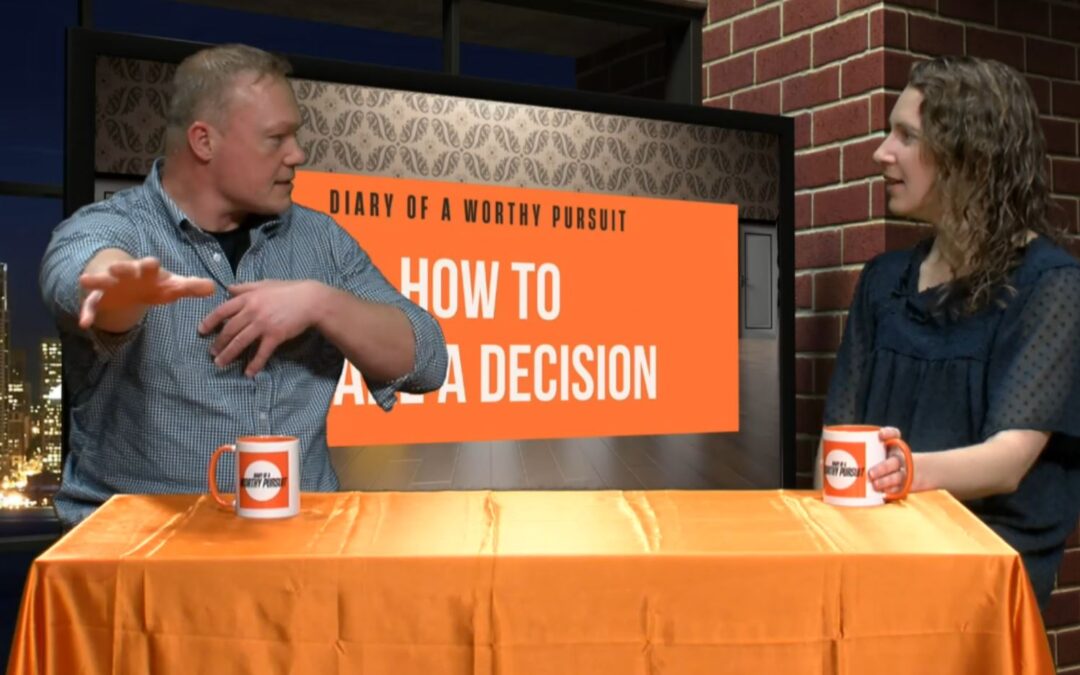


How do you make decisions?
Listen as Jenna and James explain how to improve your decision making skills that will help you choose a better life.
Enjoy!
-
How to Start a Morning Ritual
Apr 13, 2023 •
Jenna [00:00:07]: So I used to wake up in the morning in a crazy start. My kids would run in, they’d be screaming, Owen didn’t do this. Callan woke me up. Where’s my breakfast? And I roll over and it’s 06:00 luck. Awesome. Didn’t wake up before the kids, and…
-
How to Be Confident
Apr 20, 2023 •
James [00:00:06]: I’d like to tell you a story about a guy that wasn’t the most confident in the world at a moment with short cutoff jean shorts. So picture yourself let’s call it a weekend. In September, I’m in Wisconsin Dells at the Wazawa Festival, which is the end…
-
How to Reach Email Inbox Zero
May 18, 2023 •
-
How to Increase Revenue
May 11, 2023 •
-
How to Stop Procrastinating
May 4, 2023 •
Podcast Transcription:
James [00:00:06]:
So I’m waiting for my kid to get done at soccer practice. and kids after soccer practice always like to kick in the goal and mess around a little bit. Coach comes up to me, and he says, James, how’s it going? Tell me why’d you start your business. And I chatted with him a little bit because this wouldn’t be on the typical small talk parent coach kind of thing. This went into more of an in depth life choices type conversation, which is awesome. It’s incredible. He’s in a position currently where he’s not very happy with his job. He’s got another 10, 15 years before he retires, and he’s trying to figure out does it make sense to jump ship or to just tolerate for the next 10 years before he retires. And I tried to help him out, not necessarily saying this is what you should do or what I believe you should do. I tried to help him out with how to make that decision on his own. And so it’s interesting. I don’t know what he’s gonna choose. have some ideas what I’d like him to do, but in the end, it’s his life.
Jenna [00:01:03]:
Welcome to diary of a worthy pursuit. how to get what you truly want in life and business. And today, we’re gonna talk about some tips to help you make decisions. Right. I don’t know how many times in my life. I have felt like I’m at a crossroads and you get stuck. Mhmm. And so I think that this applies to so many different areas of your life, but especially when you hit these big crossroads. Yeah. Do I continue career where it is. You know? If you’re younger, where do I go to school? Do I start a business? Do I wanna get married?
James [00:01:31]:
Do I wanna buy a new car? Right? Yeah. It’s the often it’s the devil you know versus devil you don’t. Right. In this guy’s case, he’s had a job, had the same job for 20 some years, and it’s been doing well. It’s what I would consider to be a secure job. Mhmm. And a lot of times, anytime I see security, I see what is the risk of that security, or what are you giving up to have that security? Right. That opportunity cost. Yeah. It’s all risk versus reward. Mhmm. And there’s next to no risk in that that position. So does that mean that there’s limited reward? So then you’re wondering, well, maybe you should chase after a little more reward. Right. That’s what you’re after. But it’s interesting because that’s I feel why he’s having these have any thoughts or considerations? because he’s I mean, he’s probably well, I think he’s actually a little younger than I am. but I think that he looks at me with my businesses and sees some things that he wants. Mhmm. Was financial or time freedom? Or, like, I could never do what he does as a job, so he hears that.
Jenna [00:02:35]:
Whatever it is. Well, what I admire, though, about what he did is he’s clearly at a Crossroads, and he understands that he is evaluating his Yeah. And so I think it’s extremely insightful that you look at others who seem to have — Mhmm. — the direction that you want and you go ask questions. I think that that’s a a good start to making a decision. It’s just ask questions and investigate what your options are. So times, I think we’re so close minded about what we truly think is possible or we think there’s only 2 options we see in black and white. When there’s really so much more grace here we have to play with. We just don’t know it yet. Any recent interesting point. It’s almost awareness of the choice. Yeah. Where I think a lot of people in his profession or any profession
James [00:03:20]:
or just, like, I get up. I go to work. I come home. I watch TV. I go to bed, rinse repeat. Mhmm. And they’re in that kinda groundhog day, and they don’t step back and think. I suppose a strong argument now that I’m thinking that, could be made that employees now, some of the younger generation is just like every day, I think, is there something better? Like, I quit after working there for 2 days or — Well, that’s whole idea of quiet quitting. Right? Even choosing not to do what you’re doing or only going through that rat race is a choice. Mhmm. And so this whole idea of
Jenna [00:03:53]:
you realize that you have a choice, first of all, but then I think some of us get so stuck in paralysis by analysis — Totally. — that we don’t a choice. Mhmm. And I’ve heard you say before that indecision
James [00:04:06]:
is still a decision. Yes. A decision not to make a decision is a decision. Right. So you sit on the fence, so let’s take this guy. Right? If he were to say, I’m just gonna think about this. He’s still in his current job. As long as he’s still thinking about it, he’s still on his current job. So that’s a decision. Right? There’s no hold on life. I’m gonna see what’s gonna happen here kind of thing. Like, he’s just the choice at the time is made until he makes a move to change it.
Jenna [00:04:35]:
And I think people’s personality plays a lot into how you make a decision. So if you if you are familiar with the enneagram, it’s this idea that there’s 9 different personality types in each of has, you know, a core longing, a core fear, and things like that. And so some of these different personalities, the core feet is that you are going to be left without options or you’re going to be left — Mhmm. — without safety, without security. So I think it’s really important to know yourself and understand what is driving your indecision because you should listen to that. You know? If I’m sitting here saying, for me, for example, starting a business was an extreme risk, I had a very steady well paying job. Mhmm. But I have this my core longing for my personality type as much as you know, you take that is that I long for security and safety, which is really interesting because I wouldn’t have pegged myself as that. Right. But I’m an adventurer. I like to find and try new things and experience everything, but the core longing is that I won’t have options to do what I want and I won’t be safe in secure. Well, seem like 2 opposing ideals, don’t they? Well, but I think when you look at the core of it, if you have safety and security to come to. It’s safe to go out and have an experience. Oh, just like — Yeah. I can dabble a little, like, dabble. Right? That’s a great way to put it. So what I think was interesting about when I was deciding whether or not I would start a business is I looked at the the emotional side of me was like, I wanna do this now. ready to do this now because I’m a adventurer. I’m like, I wanna go try this new thing, this new experience. But the logical side of me was like, but how is this.
James [00:06:19]:
Oh. And
Jenna [00:06:21]:
— How safe is anything really? Exactly. Well, but this comes back to something that seems to be a theme for you and I is the idea of what questions are we asking ourselves. Mhmm. So I could have asked myself, is this a financially smart decision to quit my, you know, good paying job and start a business? And the answer to that would probably be no. Right? So if I made that — At least initially. — forever. Very, very great point. So, again, that’s my small frame. Black or white. Sure. But — That’s either a yes or — Right. It’s a yes or no question. But the gray area could be or the better question I could ask myself what other opportunities do I have? Or what direction could I take? How could I make starting a business possible? And those are all open ended. They allow me to dream. They allow me to come up with answers in that gray space and maybe come up with 2, 3, 4 options. that weren’t my initial 2.
James [00:07:17]:
Alright. I like that idea of the opportunity cost for not doing something. because you could’ve said, you know what? I gotta stay at this job because you got the steady paycheck, the vacation, or whatever. But that is at the call of you being able to start your own business. Right. So but then vice versa. You start your own business. You can’t have the job. Right? It’s a jump off the diving board of 2 feet. Yeah. Anything. interesting. But what I also like about what you brought up is the idea that
Jenna [00:07:46]:
earning potential. Mhmm. So I’m looking — — ceiling. — there’s no ceiling when I have my own my ceiling is the amount of effort I wanna put in, my big ideas, you know, where I wanna take the company, how big I can think not a company’s idea of where I can go. And I think that’s the reason for a lot of people starting a business is they don’t wanna put their hard earned time as money into someone else’s pocket. If I’m gonna work hard, I want it to be because I’m growing something. But that idea, I think, again, You’re looking at your earning potential in a full time job versus, well, what could be my expansive potential
James [00:08:20]:
in my own business? Yeah. That’s he said there’s, like, 50,000,000 questions that come up there. Right? because, like, 1, what can you earn? Mhmm. 2, what do you want to earn? The 3, arguably, most important is are you willing to do what you need to do in order to earn that? Like, are you willing to get out and sell? Right. If you’re not, maybe sit at can do your old job. Right? Well and that comes back to this whole idea of know yourself. Mhmm. So what do you enjoy?
Jenna [00:08:44]:
I’ve talked about this before, but there’s this idea of a a freedom Compass. It’s really this matrix of what are you proficient at and where do you passionate in. And so you can write this down and create this matrix and say, okay. Those things that I’m not proficient in and I’m not passionate in, that’s my drudgery zone. So I wanna make sure that the things that I do every day don’t have me stuck in that zone that just drains my mental and physical energy. Right? In the drudgery zone. Yeah. I mean, it’s it’s kind of like a decompressing word, but it’s so true. Right. And then you’ve got your desire zone. That’s where you have high passion, high proficiency. So if you can start thinking about the things that you enjoy doing, the things you like to do, and see what falls in that passion and proficiency zone. Yeah. Then I think you’ve got a better shot at saying, well, does talking to people really fit in this area? And if so, then maybe I am okay starting my own business because I’d be comfortable selling. But I don’t like doing that. And my favorite thing to do is, you know, look at spreadsheets or show up at a certain time and leave at a certain time, then maybe entrepreneurship isn’t for me. That’s interesting. The whole drudgery zone thing. I’m thinking about this guy. I wonder if his the majority of his job He’s in the drudgery zone. Fair point. So I wonder because, I mean, he’s had this job for at least 2 decades. I wonder if maybe it started
James [00:10:03]:
with a passion. Mhmm. And then I suppose, like, just about any relationship eventually becomes a treasury. Right? Yeah. If you don’t work on Yeah. Right? Interesting.
Jenna [00:10:12]:
I like it. What do you call that? The drudge it was called the the Freedom Compass is the tool for Michael Hyatt. You can Google the Freedom Compass Alright. But it’s a really helpful exercise. I think to think through what what do I enjoy doing as you think about maybe a second career or starting your business. Mhmm. So you really shed some light on it. And you gotta be honest with yourself. Right? Because if you’re like, yeah. I love talking to people, but do you, everything?
James [00:10:36]:
Do you joyce serving clients every day. And if if not, that’s fine. That’s not for everyone, and that’s great. Mhmm. I just said speaking of value. I just had a conversation, essentially, just probably 6 months ago. I had a conversation with one of my employees about pay, which I get right, they they’re trading time for money. whatever. That’s the thing, but she was asking about, essentially, about infinite raises. And I essentially told her that doesn’t happen because there comes a point where you just can’t offer anymore. You can’t because you’re trading time for money, so there’s only so much time. So I give the example of a plumber. Plummer first starts out there in apprentice. They’re making whatever. They move on. They graduate to whatever the levels are of plumber. I’m not a plumber, so I don’t know. But they go through these things, and they’re making pretty big pay jumps. But, eventually, they’re gonna either plateau or the pay jumps are gonna be marginal. Mhmm. Because someone’s not gonna pay $5,000,000,000 to fix their clogged sink. Mhmm. Whatever the market says, like, hey. clogged sink is whatever. A couple hundred something like that, it takes you an hour. Well, okay. Your cap is that. Minus expenses. Right. So as a plumber, I can’t make $5,000,000,000 an hour. Even though I’ve been doing it for 40 years, right, but no one cares. Because the person that’s been doing it for 5 years is doing it for a fraction of that, and they can unplug a sink just as well. Right. So the same thing in our situation with the the business that I have, like, you get super good and you make the big jumps, but, eventually, they’re gonna be lesser jumps because there’s nowhere to jump to. she has to go into management or ownership or something like that. So it’s interesting in having that conversation because it all came down to value. And I think a lot of people, when they’re in a position where they’re in the same job for a long time, I think they’re like, oh, I’ve kinda reached the peak. He Like, there isn’t another rung because this is just the business. Right.
Jenna [00:12:34]:
And I think that some people miss that that site of seeing themselves as what’s the value I bring to the market. Oh, right. So when you see your expertise as having value in the market, then you see the value you bring to your employer and then what that value is worth. Right. But I that, again, this falls into your decision making when you can say, is the value that I’m bringing over here worth what I’m getting paid, and that a very subjective answer. But if you don’t agree with that, then you have the opportunity to, well, I sit here, and I tolerate which I feel like a lot of people are stuck in right now. After the pandemic, we all kinda wanted to be safe and we didn’t have a lot of security necessarily. So people Let me just stay and hang out. But now there’s that other option of, well, what what would happen if I were to take a risk? Mhmm. What could happen if I were to take a risk. And I think that that’s the opportunity that your coach friend here was trying to grapple with. Right. Trying to figure out what’s going on. Right. quickly. Another thing that I was talking to this guy about was the cost of not making this a decision. Mhmm. An interesting thing that I
James [00:13:46]:
was trying to allude to. I don’t know if you ever saw the movie up in the air. No. Up in the air, George Clooney. Oh, yeah. His job is to fire people. Right? And he asks the bald actor that seems to be in every movie, but I can’t think of his name right now. — either. This is George Clooney’s firing him on behalf of this other company. And George Clooney asked this question how much did they did they have to pay you to give up your dream? And this guy is, like, $29,000. because he went to school. This the bald guy went to school to be a chef, and he’s at some business working at desk, accounting, or whatever. was. Yeah. And so George Clooney’s like you go to school to be his gourmet chef, and you end up behind a desk. So now is your opportunity forced opportunity — Mhmm. — to go do what your dream is. Mhmm. And then George Clooney goes on to give him speech. Right? You were a bra? Yeah. Like, you get kids. What are your kids’ perception of you doing this job that you hate? means you probably come home all multi versus doing what you love where it’s a whole different lifestyle. Right. So who’s watching you? Mhmm. So the decision is not necessarily just for you. It’s for everyone that’s watching you. And some people around you you may not care or whatever. Right? There’s just some person on the street. But if it’s your kid, or your spouse — Mhmm. — different story. Right. So it’s kind of puts a little bit more of a challenge, I guess, in getting the decision right. But certainly to make the decision consciously.
Jenna [00:15:13]:
Yeah. I think what’s interesting about that too is this idea of a a forced opportunity. Mhmm. Right? So sometimes we find ourselves in situations where we’re evaluating because something’s not quite right. You know? There might be dissonance of what we have to do versus maybe what we dreamt we would do or something like that. But that’s, you know, kind of a privilege that we have. Right? There are more job opportunities. He has other options. Right? but
James [00:15:40]:
a layoff or, you know, downsizing in some of these corporations. Again, that’s happening a lot right
Jenna [00:15:42]:
now. especially in the tech space. Mhmm. So as you see more and more of these posts on LinkedIn of, you know, open to work or I’m I’m was just laid off, it is a forced opportunity. And I think this comes to that idea of mindset of How are you looking at this decision making process? Right. You know, if it is a, well, I got laid off, and now I have to go find something else. Okay. or if you were stuck and you weren’t really fulfilling your dream, this is your opportunity. This is your inspiration to go live it. So I think I’ve been accused sometimes of saying everything’s an opportunity.
James [00:16:25]:
Because to me. That doesn’t sound incorrect.
Jenna [00:16:29]:
I think maybe it’s applied liberally. Okay. But it’s the the way that you look at things. Right? So if I see this as a challenge, it’s gonna be really hard for me to overcome, like, ugh. I’m gonna switch field. That’s gonna be so hard. Or, oh, I wanna start my business. That’s gonna be so hard or if I see it as an opportunity, look at this cool thing I get to try. And if it works great, and if it doesn’t, not a big deal, but I get to try it. That’s so whole different approach to making that decision.
James [00:16:57]:
You would raise an interesting point about something being difficult, though, because just because it’s difficult doesn’t mean it’s necessarily bad Right? Or that you shouldn’t do it. Mhmm. And if it was easy, you probably wouldn’t do it because you’d be bored.
Jenna [00:17:09]:
You know, that’s fair. And I wonder how many people are in a place where they are right because they’ve always made the easy decision. Totally. Totally. And then, you know, you get to a point where the easy decision just doesn’t serve you — Right. — anymore. Half of least resistance? Yeah. Exactly. Yeah. Terrible. Terrible way to live your life. Yeah. You — In my opinion. Well, you will never get where you wanna go if you don’t know where that is. freight.
James [00:17:30]:
Yeah. It’s one of those. You know, it’s funny. I have a friend who, I mean, from spouse, job, everything. path of least resistance. Super nice guy. Love hanging out with him, but it’s one of those. Like, I can’t talk to you about growth or anything. Like, we don’t talk about that. We talk about cars instead because his life is pure path of least resistance. Even the food that he eats kinda thing. Like, where should we eat? Well, the restaurant’s right here. Yeah. We’ll just we ran I didn’t even turn the steering wheel. It just showed up. Uh-huh. It’s funny. And it’s interesting when I look back, like, oh my gosh. that is crazy. But it’s inspiring because you’re like, nah. I don’t wanna do that. Mhmm. You gotta go for something. sometimes we make better decisions by looking at what we don’t want — Totally. — then seeing what we do. Yeah. Earnings are examples. Right? You look around. I’m like, oh, would it be that guy? Uh-huh.
Jenna [00:18:23]:
Man. I I have found that. parenting. I have seen plenty examples of at least from the outside, what I don’t wanna be as a parent. I’m sure in the moment when I’m with my kids, I’m probably that person with no idea. But there’s plenty of examples. Right? — now that Jen is doing. But, you know, when you’re on the outside in not your own kids. You’re like, oh, I can see how that’s helpful, or I’m never gonna do that. Alright.
James [00:18:43]:
Interesting. Yeah. I suppose the choices in parenting.
Jenna [00:18:48]:
That’s a whole new ball of wax right there. Well but it comes back to that whole idea of of self awareness and making the decision of making decisions based on your ultimate goal. And that’s not really something that we’ve chatted about here yet, but it’s that idea of what is this coaches ultimate goal. Like — Oh, so the — The big thing. Yeah. Like, what’s the big nut he’s chasing? Yeah. So if he is chasing I just wanna have a ton of money in retirement. Right. So financial freedom. Yeah. Okay. If that’s what he’s chasing and he doesn’t like volatility, he like safety, then cool. Maybe staying the course is a good place. Mhmm. But, you know, the other option is you take a risk. Right. You could fail. Or you could do great. Yeah. I wonder. because you raise an interesting point. Right? The big goal because that’s the little stuff doesn’t really matter as long as you’re headed in the right direction towards your goal. if it goes financial,
James [00:19:39]:
or I suppose it could be just health. Mhmm. Like, he’s in a job right now where he just hates it. So I can’t imagine spending 8 to 9 hours a day hating what you’re doing. Like, what does that do to your body and — Mhmm. — your mindset, your perception of the world, how you treat your kids and friends and all this kind of stuff. Right. Because you carry that angst with you. Yeah. And even like, it’s interesting that you say that right now because he’s his nice guy, sharp guy. So then you wonder, like, that means that he’s carrying that baggage hidden — Mhmm. — which then is, like,
Jenna [00:20:11]:
You can have a stroke man or a heart attack or something like that. Yeah. Well, we were talking before we started here today that the just that stress that emotional stress of indecision, not making a decision, or just that ex existential angst — Mhmm. — of what my purpose? Where do I belong? You know? What where should I go? What’s my next best path? That really takes a toll on your body and not taking action makes it worse because, again, indecision is a decision, so I’m ruminating in this all the time. Yeah. And then that can get stored, and it can actually manifest in physical ways if you hang on to it for too long. Totally. I think it’s good to
James [00:20:48]:
forgive yourself to not have the guilt that your decisions got you where you are because past doesn’t equal future kind of thing. So I think a lot of people would get stuck saying, oh my gosh. How did I get here? Right. Kinda thing. But in the end, it doesn’t matter. You get to choose where you’re going forward. Right. So forget about the past. Forget about what got you to this moment. Chocked it up to experience and move on. Mhmm. And let’s find next steps. Right. So it’s interesting because I guess now what I’m thinking about that. I wonder if there’s a little bit of guilt where he’s stuck in. Interesting. I don’t know. That’s a conversation I’ll have to have with him over Yeah.
Jenna [00:21:23]:
So, you know, I think the another thing we’ve talked about is this we’ve talked about safety. Mhmm. And we’ve talked about risk. I think everyone has a different risk tolerance. Totally. But I was reading this article about a woman who wrote a book. She was a hospice nurse. she was interviewing people at the end of their life and asking them, you know, what are your biggest accomplishments and what are your biggest regrets. And their biggest accomplishments were never typically work related. It was like I, you know, I raised good kids. I maintained a marriage or whatever that might be, but their biggest regrets also were not work related. Alright. It was not I wish I would’ve spent more time work, or I wish I I regret that I didn’t get that promotion. It’s the risks they didn’t take. Alright. So things like, I wish I would have started a business. I wish I would have asked that girl out. I wish I would have tried harder my marriage. I wish I wouldn’t have worked so hard, so I could have spent quality time with my kids. Oh. And so it’s so interesting because what I take from that is you’ll always regret it’s safe. Mhmm. Because otherwise, on the other side, you’ll regret the decision the risk you didn’t take. Yeah. That’s fair.
James [00:22:37]:
That’s kinda it’s enlightening because you think these are people that know that they’re on death’s doorstep kind of thing. And they’ve had a lot of life at hopefully, there’s a lot of life experience. Decades. Decades. Just to imagine all the stuff that they’ve seen. Right? Right. Whereas depression, different wars, Twin towers, like, all the stuff, Internet being born. Right. Right? Telephone’s going away more or less. Right. Like, it’s interesting. from all their life expects experiences. And I wonder if the decisions that they regret
Jenna [00:23:08]:
are any different than people that were born a 100 years before them. It’s a really good question. You know, we wonder how much technology changes our lives, and it’s supposed to make things easier. But instead, we just spend more time in it, and we spend more hours working with it. And so — — on social media more. Yeah. Right. You said no one ever. I wish I would’ve screwing more. I didn’t see the end of the day. Even now, everyone’s like, ugh. I just wasted an hour doing scrolling. Yeah. But I think, yeah, it’s extremely good insight to there’s a I don’t remember who wrote this. Oh, it’s in how to win friends and influence people. Okay. Alright. He yeah. He talks about writing your eulogy. Oh. And so not to be, you know, completely morbid, but it’s that idea of at the end of your life, what do you want people to say about you? Right. And so if you think about your life through that lens, then can making your decisions now drive you to the person that you wanna be someday.
James [00:24:02]:
Interesting. Right? Your own eulogy. Yeah. Oh, creepy.
Jenna [00:24:07]:
Creepy. But valuable? Right. But also valuable because if your eulogy is something like You know, he was he was the kid’s soccer coach, and he showed up for everything. He never missed a game. He he was best friends with his son. He was Best man in his son’s wedding, you know, all of these things. That’s a whole different eulogy than, like, he published 56 books and he was on the best seller list 19 times. Mhmm. And, you know, that’s a it’s a very different eulogy that isn’t people oriented. And I guess everyone has to be people or family oriented, but it’s about knowing your values to say, okay. My values are family, so I’m gonna make sure that whatever decisions I my family is my first value that I’m driving toward. So not necessarily good or bad, which you have the goal in mind — Right. — which you want. Exactly.
James [00:24:54]:
had the greatest podcast. Right? Right. Exactly.
Jenna [00:24:57]:
And all the decisions made with that.
James [00:25:00]:
Oh, what else we have here? I guess In the end, it comes down to being conscious of the the decisions that you need or have the opportunity to make. Mhmm. appreciating what has gotten here, not living in regret — Right. — or letting that stop you and being aware who’s watching you, what you’re teaching them, Yeah. And widening your options because they’re typically more than you think. Oh my gosh. So many more. Yeah. Yeah. It’s interesting. You and I were just talking about this earlier. I thought of movie speed — Yeah. — when Keanu Reeves is like, shoot the hostage. And it was at Jeff. I can’t think of his name. Jeff Bridges? Jeff? somebody? Oh, Dennis. How far you mean? But who’s the other good guy that’s hanging out? Oh, yeah. Tell him, shoot the hostage, and the guy’s like, what? shoot the hostage. I can’t remember. And then later in the movie, spoiler alert. Right? He ends up shooting Jeff guy — Right. — which is funny because most other people would not even consider that. Mhmm. Khukian was like, take them out of the equation. So it’s interesting. It just opens up some perspective where you’re like, just because you think you have these are your decisions. Mhmm. Your 2 or 3 decisions whatever. that number is actually pretty infinite. Yeah. In the end, I suppose if you just get a whiteboard or hang out with a friend and have a beer, you can figure it out. Right. Figure out different options and find something that inspires you or maybe weren’t aware of. Mhmm.
Jenna [00:26:25]:
One more tool that some of my mentors continued to encourage me on that I’m working toward is journaling it out. Alright. So that idea of, like, okay. I think this is the direction I wanna head. Let me dive into that. Because sometimes seeing your feelings or your thoughts come out on a rich page is very different than saying it — Oh. — to someone and sometimes writing it just helps people process it. Totally. Yeah. Especially if you’re free writing. Mhmm. So that’s the whole idea behind people doing morning pages. Right? It’s just letting things flow and seeing how they react to things. But then taking a break and giving yourself some space and coming back to that decision and okay. Does that jive with who I wanna be? Does that jive with my values? I have seen it really help people.
James [00:27:10]:
I am I have that as a goal. Someday I will get there, but I’ve seen it be a really useful tool in decision making. Yeah. When I wrote my book, — Yeah. — it was interesting because there are times that you’re just, you know, typing away, I guess, might hunt back typing. Mhmm. And I’d walk away and come back and read what I wrote. And I’m like, don’t know who wrote that, but they’re pretty awesome. And it didn’t feel like it was me. Yeah. Like, I’m like, that’s cool. Mhmm. And then you’re like, wait. You wrote that. it was one I don’t mean to be, like, not humble or anything, but it was one of those where when you get in that zone, you kinda take for granted all the stuff, the experience, the education, all that kind of stuff, and it can just flow. And there’s even times still that I pick up my book, and I’m like, that’s good advice. I should take that. I did it before. I should take it, which is kinda it’s interesting. So I imagine everyone that’s got the same thing. You put it down on paper. Yeah. think we undervalue ourselves sometimes unless we actually
Jenna [00:28:06]:
paper’s a really nice way of just making it objective. You know? Put it out there, put it in the world, come back to
James [00:28:12]:
Yeah. You remind me of the business plans when I was teaching business planning class. Yeah. People had their ideas for business, just magical rainbow moonbeams. Mhmm. And then put it on paper, and you find out either that’s not financially viable, or you’re gonna have to work 20 hours a day to make that vital. I took just an example really quick. I had a woman that was gonna start a retail store. It’s gonna be open 9 AM to 9 PM, 7 days a week, but she wasn’t gonna have employees. But she also gonna not gonna have a life? Yeah. So I’m like, no. No. No. No. No. No. And at first, she’s like, what are you talking about? This is my dream. I’m like, No. That’s a prison. That is totally a prison. You’re building a prison because day 1, 2, week 1, 2, sure. Fine. Whatever. You’re like, yeah, yeah, honeymoon period. But on week 3, when you’re there for 12 hours and no customers have walked through the door, you’re gonna be like, no. What did I do? I got a 5 year lease here. something like that. So in that case, getting it on paper was a very good way to transfer it from emotional,
Jenna [00:29:12]:
dreamy. Yeah. To that logical, like, okay. How can we make this work? Mhmm. And I think you need both in decision making. Totally. Right? It’s nice to have the emotion. It’s nice to have the excitement. Yeah. But some logic behind it in either situation. You know? If you’re usually a more logical person trying to find out your why and your motion behind it — Mhmm. — or if you’re usually more of a logical purse or I’m sorry. If you’re usually an emotional person — Mhmm. — trying to sit down and actually map it out to what can this really look like can help.
James [00:29:37]:
Definitely value in both. So this has been diary of a worthy pursuit. But we talk about how to get what you truly want in life and business. Thank you. And I suppose you could just get a magic cape. Alright?
Jenna [00:29:49]:
Let us know how that goes for you. Otherwise, we hope these tips were helpful in making your next decision. Have a good day.